Friday, January 26, 2018

Twitter Is Like Going to the Grocery Store


A few months ago, I took a group of teachers to visit the Ron Clark Academy (RCA) in Atlanta. It was an amazing experience to see the school up close and learn along with educators from all across the country.

During the opening, Ron Clark shared that visiting the school is kind of like going to the grocery store. When you go, you don't take home everything that is on the shelves. You pick out the things you need, the things you like, or the things you want. But you have lots of options.

Everyone is not going to fill their shopping cart with the same items at the grocery store. Likewise, not everything that happens at RCA will work for every teacher, every classroom, or every school.

However, there are some amazing selections for you to consider. And if you are passionate, creative, and inspired, you will see all sorts of ways you can bring pieces of RCA to your work. 

And if you've lost a little of your passion, creativity, or inspiration, you might just rekindle that too!

I think the same can be said for building a Personal Learning Network (PLN) and connecting on Twitter. Not every idea you encounter on Twitter will go in your shopping cart. 

Some things might not work for you right now. You'll pass over those. 

Some things might seem too big to fit in your cart right now. You can consider those again in the future.

You might only go shopping once a week at first. Later, you may want to stop in daily to see what's new.

That's what's great about it. It's completely up to you. And customized for you. With a little skill, you can get out of it what you need, whenever you need it.

Twitter is actually more like Amazon than your neighborhood grocery. Part of Amazon's mission is to be a place where "people can find and discover anything they might want to buy online." 

Twitter is like that for educators. You can connect with people who are like-minded and get ideas and support for just about anything you want to accomplish as an educator.

And you can do it just about any time and any place that works for you.

It's a total game-changer. 

Jeff Nelson adapted the following list from my satirical post about Twitter PD. I admit I had fun with the satire, but he put a positive spin on it. There are just so many reasons for educators to use this tool. It's such a great way to grow and learn.
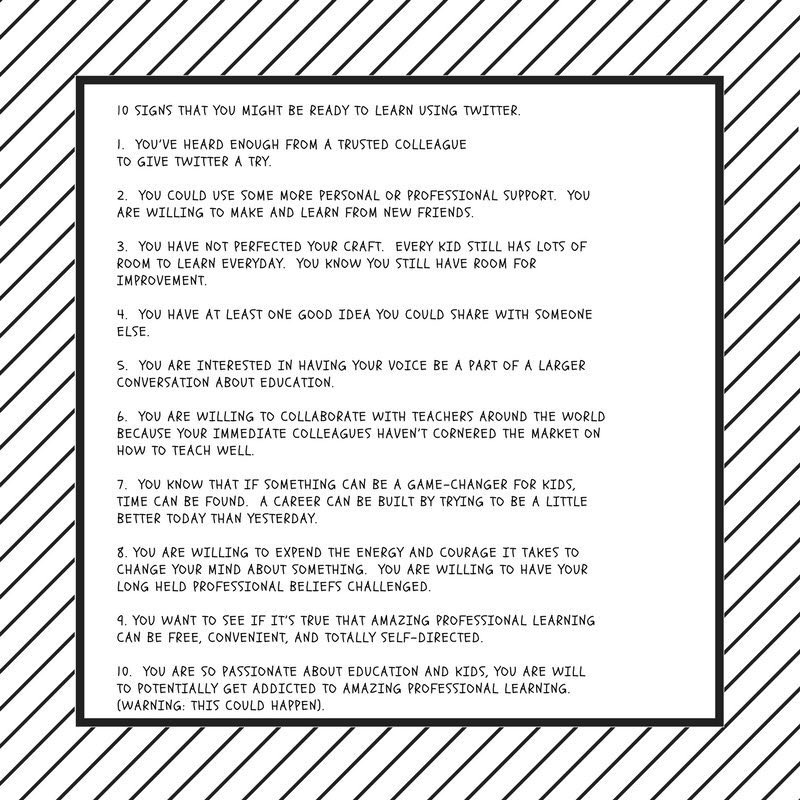


Who else thinks Twitter is a game-changer? How has it impacted your work as an educator? I want to hear from you. Leave a comment below or respond on Facebook or Twitter.

Wednesday, January 24, 2018

Do You Want Your Child to Grow or Do You Want Him to Be Comfortable?


We have a basic speech class that we require just about every student in our school to take. It's not a graduation requirement, but our counselors include this semester class for all sophomores unless there is some compelling reason they just can't fit it into their schedule.

We expect all students to take it because we know how important it is to develop good oral communication skills. The class includes public speaking components, but it also provides practice with interpersonal skills and interviewing. It's essential stuff for life.

You've probably heard it stated that people fear public speaking more than death, in surveys at least. So inevitably, there are students who don't want to take this course. And from time to time, I will here from parents who don't want their child to take the course.

Jerry Seinfeld found the humor in just how much most people dread public speaking:

“According to most studies, people's number one fear is public speaking. Number two is death. Death is number two. Does that sound right? This means to the average person, if you go to a funeral, you're better off in the casket than doing the eulogy."
I get it. Public speaking can produce anxiety, dread, discomfort, apprehension, and more.

As a result, I always listen carefully to parent concerns and try to show empathy and understanding. It can be scary to stand in front of your peers and speak.

But I'm not easily persuaded to change our expectations about students taking this class. It's an excellent opportunity for students to grow and develop all sorts of valuable skills.


So, my dialogue with parents asks them to consider what's best for their child:

"I understand this class makes lots of students uncomfortable. But that can be a good thing because growth requires stepping out of comfort zones. We don't grow stronger by doing what's easy. When we face something hard and push through it, that makes us stronger. So I'm always asking myself as a parent, do I want my kids to be comfortable or do I want them to grow? And the answer, of course, is I want them to grow. Isn't that what all parents want for their kids?"

And of course, parents do want their kids to grow, but for some reason, we've developed a desire in our culture to protect our kids from anything that is uncomfortable or difficult. It's very common to see parents protecting their kids from anything that produces discomfort.

But we can't have it both ways.

Growth demands stretching the limits and trying something new. Growth demands risk of failure. It requires some discomfort. So we need to invite kids to embrace the discomfort. And we need to invite parents to encourage discomfort and not rescue kids from the struggle.

So I will continue to share with everyone in our school my belief that we have to get uncomfortable if we want to be all we can be. We have to push past our fear and go for it.

Do you have tips for helping parents understand that it's not a bad thing for their child to be uncomfortable? That productive struggle is a good thing? I want to hear from you. Leave a comment below or respond on Facebook or Twitter

Sunday, January 21, 2018

5 Questions Every Kid Is Trying to Answer


When we think about creating a stronger school culture, we know how important it is to focus on relationships. But why are relationships such an important part of an outstanding learning environment? It seems clear when you think about it. Everyone needs to feel connected. Everyone needs to feel like he or she matters. 

Everyone needs to matter!

All. Of. Us.

It's through relationships we create the supportive, inclusive, positive, and caring place we want to see. A place where people can thrive. A place to be great. A place to reach higher and do more.

Students are trying to answer these questions. And adults are trying to answer these questions too. The title of this post might be focused on the kids. But all of the adults in the building have these needs as well. These questions are essential to us all.

1. Am I important to someone here?

2. Do I belong here?

3. Am I good at something here?

4. Who will listen to me here?

5. Is my presence here making a difference?

As we work to improve the culture of learning in our schools, we should always keep these questions in mind. Can students and staff members answer these questions positively and confidently? What are we doing to build stronger connections and take care of each other?

This week every chance you get, look for ways to help others find the answers to these questions. You can show another person they matter to you. You can lift them up and make them feel like they are valued for who they are. You can show them they are heard. You can notice the unique talents and gifts they have to offer the world. You can show them how they are making a difference.

What are ways you are helping your students and your colleagues answer these questions? Who will you lift up this week? Leave a comment below or respond on Facebook or Twitter. It's always a privilege to connect with you.

Friday, January 19, 2018

Difficulties Make Us Bitter or They Make Us Better


With less than a minute left in the game, we're up by one point and inbounding the ball from under our own basket.

The ref is counting, and it's getting close to a five-second violation.

You'd think a turnover might be the worst thing that could happen here. But you'd be wrong.

Our inbounder senses the need to avoid the 5-count. He throws the ball long, toward the other end of the court. It's a common play, almost a safety valve.

But when our player catches the ball almost without breaking stride he runs for the opponent's basket and lays the ball in the basket effortlessly.

That's right, he scored for the other team.

With less than a minute on the clock. Against one of our biggest rivals.

We went from up one to down one in a flash.

How could this happen?

The large and enthusiastic home crowd went suddenly quiet.

Our coach immediately called timeout. Within seconds, teammates were speaking encouragement to the shocked player. I can't imagine how he felt when he realized what he'd just done. You could see his disappointment.

In the huddle, our coach reminded his team, "Next play. Next play." We always move on to the next play. We don't dwell on our mistakes. We play through our mistakes. We don't blame, or point fingers, or pout, or feel sorry for ourselves.

We move on to the next play...together.

He stayed in the game. Coach didn't take him out.

With only seconds on the clock, we hit a three point shot to put us up by two. But then the opposing team came back and tied the game just before time expired. Unbelievable.

Two overtimes later, our Liberators pulled out the win. And the kid who scored for the other team hit a huge three point shot of his own, at our basket of course.

It's nice that we won. It makes me happy for our kids when we win. But I'm far more concerned that our kids learn to play like winners. And that's what I saw in the finish to this extraordinary game.

Over the years, I've also seen teams that haven't handled adversity well. It never ends well.

Instead of lifting each other up, they bring each other down.

Instead of being unselfish, they put ME before WE.

Instead of accepting their role, they feel sorry for themselves.

Instead of believing in each other, they believe they deserve more.

Instead of supporting the coach, they think they know better.

And it's not true just for sports. It can happen in your school, with your family, or at your church. 

Difficulties can pull us together, or they can tear us apart.

They can make us bitter or they can make us better.

The best people rally together in hard times. They don't panic or act poorly simply because there's adversity. They believe doing things the right way will eventually lead to great things coming your way.

It might not happen in this moment, in this game.

But in life, if you're surrounded by good teammates, you'll never fail alone. Your team will be there to pick you up, even when you score at the wrong basket.

You'll move through the difficulties. You'll learn from them.

And eventually, if you keep doing the things successful people do, you'll give yourself the best chance to be successful.

How are you responding to difficulties? Are they making you bitter or better? I want to hear from you. Leave a comment below or respond on Facebook or Twitter.

Wednesday, January 17, 2018

11 Must-Have Qualities of Authentic Leadership


I could tell she felt overlooked and undervalued as she shared what happened. I just tried to listen and be as understanding as possible. She felt like a leader had let her down. She felt diminished.

And I hate to see someone feel that way.

She had gone to a lot of work. It was a job well done. But she felt like no one noticed. At least, he didn't notice. The leader hadn't noticed her efforts.

Maybe she felt like no one ever notices? Her words came out defeated.

I felt empathy for her. But I also felt empathy for the leader. I don't think it was intentional. In fact, I'm almost certain it wasn't intentional.

And I couldn't help but think there were probably times someone else felt that way about my leadership, in spite of my best intentions.

Leadership is tough. Whether you're a principal, a teacher, a parent or just about anyone. If you've been in a leadership role, you've carried an important responsibility with that. It's a responsibility to your followers, to the people you're leading.

You feel that weight, that responsibility...if you're a good leader.

But you also know at some point, you're going to let someone down. Someone is going to be disappointed. They're going to feel like you made the wrong decision. Like you devalued their work. Like you didn't give your full support.

So let's just keep this in mind. Effective leadership must give grace.

But leadership needs grace too.

In the end, we can't expect our leaders to be perfect. We just need them to be authentic.

And we need them to do what's right and to always care about their followers.


So what does it mean to be an authentic leader? It doesn't mean you're perfect. You'll probably still fall short sometimes. But it does mean you're willing to be open, honest, and real. And it means you'll do everything you can to step up for the people counting on you.

Here are 11 Must-Have Qualities of Authentic Leadership. These are challenging for sure, but they are the qualities I aspire to meet. Of course, too often I fall short. But I'm still trying.

1. Lead with your heart.

It's important to care about others, not just for what they can do for you, but because you genuinely care. Because they matter. When you lead with your heart, you also listen with your heart. Be understanding.

2. Shoulder blame.

When something goes wrong, don't try to minimize it or deflect it. If it was your mistake, just own it. Apologize for it. Make it right. And then move forward from it.

3. Share credit.

Invest in the success of others. Be generous with recognizing their contributions. Be happy when they do well, in their professional or personal lives.

4. See the best in others.

And believe the best in others. Lift them up. See them for all the good they are and all the great they are becoming. Never underestimate someone or diminish their abilities. Never.

5. Seek criticism.

Authentic leaders want to know what they can do better. They want to know how their followers are experiencing their leadership. They want feedback, even when it's critical.

6. Lead with optimism.

Your attitude, positive or negative, will determine what kind of leader you will become. Effective leadership hinges on choices, not circumstances. Good leaders are positive even when things are tough.

7. Speak with honesty.

There is no effective substitute for the truth. Authentic leaders always speak truth, but they do it with all the understanding, care, and concern that's possible.

8. Manage emotions.

Leaders must have their emotional abilities in hand. It's difficult to lead if your emotions are running your life. You must feel all your feelings, even the distressing emotions. But you must respond in healthy ways, and not react in destructive ways.

9. Be a positive example.

Do what's right, not what's easy. Whatever qualities you want to see in others, demonstrate those qualities. Your example is your influence. It's the most powerful thing you have. Everyone is watching to see what the leader will do.

10. Be courageous.

Be willing to take a risk. To set things in motion. To move ahead. Lots of people see ways things should be different. A leader is willing to take action and lead others to take action to make things different. But it requires courage.

11. Be willing to grow and learn.

Authentic leaders do not have a rigid view of themselves. They are open to changing their leadership when they learn something new or they are presented with new information. It's important to be flexible and always be learning.

What else would you add to this list? How would you take these ideas deeper? Leave a comment below or respond on Facebook or Twitter. Your feedback makes us all stronger.

Sunday, January 14, 2018

5 Simple Rules to Be Great


An essential for being successful is to know who you are and what you have to offer. Your experiences help bring a fuller knowledge of yourself and how you can make the greatest impact. You have to believe in yourself and be willing to take risks to test your limits. 

These truths apply for anyone, not just teachers or educators. We need to help our students discover this process too, so they can be their best and reach for their potential.

1. Focus on your strengths.

It's easy to focus your mental energy on your weaknesses. That's actually what most people tend to do most naturally. But it's far more productive to build on your strengths. If you focus on how you don't measure up, you'll hesitate to step up. You won't make the impact you're capable of making.

2. Exercise your gifts.

You have gifts that you need to develop and share. What excites you and energizes you? What makes you want to do more and be more? What qualities do your biggest fans see in you? Don't discount these gifts. Exercise them and leverage them. Share them with the world.

3. Have courage to be different.

To be great, you'll have to be different. And that might make some people uncomfortable. Don't let other people shape you in ways that don't feel right for you. You have to be true to yourself and do the work you were made to do. You can't be a standout if you're just trying to fit in. 

4. Continue growing and learning.

When you continue to grow, you may find opportunities to reinvent yourself in ways that surprise you and delight you. It's a shame when people hold on to their view of themselves in self-limiting ways. They cling to a feeling of safety and security in who they are and don't risk questioning that they could be so much more.

5. Cope with your critics.

Always remember that it's not the critic who counts. At the end of the day, you have to be satisfied with who you are and what you are doing with your life. Make up your mind to learn from critical feedback. It can be helpful. But don't let criticism slow you down. Keep pressing forward and believe in yourself. Don't let anyone diminish your abilities.

What would you add to list list? What do you think it takes to be great? Leave a comment below or respond on Facebook or Twitter.

Friday, January 12, 2018

Is Your School Extraordinary?


Think about the best dining experience you ever had. What made it exceptional? Was it the service, the atmosphere, or the cuisine? How was the experience more than just a good meal? Why was it truly memorable?

We recently asked our teachers to reflect on these questions during a faculty meeting. And the point of the reflection wasn't to assess what kind of foodies are among our staff members. However, our culinary arts teacher (@BettyGlasgow) had plenty to say on the topic! 

Our chief aim was to examine what makes an extraordinary culture for a restaurant and how can that relate to creating an extraordinary culture in our school. Most everyone can recount a dining experience that was truly outstanding. What made it different?

One of our instructional coaches (@ealove21) had participated in a similar activity in a graduate class. In the end, our goal was to draw parallels between an extraordinary dining experience and an outstanding classroom experience.

Our staff talked about things like how they were treated by the wait staff. How they felt like they were the most important guests ever. They shared how there was attention to just about every detail. How the atmosphere made them feel wonderful. They explained how the entire experience exceeded their expectations in every way. And of course, the food was outstanding, too.

If I just want to get a decent meal, my options are endless. But if I want a truly remarkable dining experience, there seem to be only a few restaurants meeting that standard. There is something extra that really makes it stand out.

Can the same be said for schools too? Are we providing something extraordinary? Is your classroom meeting expectations or exceeding them? Is your school truly excellent or doing pretty much what every school is expected to do?


Our next part of the conversation with our team was to ask our teachers to consider the basic expectations for schools. What exactly is it that every school should be doing? What things are just the minimum requirements?

Should every school love kids? Yes.

Should every school be a safe place? Yes.

Should every school implement engaging, relevant curriculum and instruction? Yes.

Should every school work together with families and the community? Yes.

Should every school promote life-long learning? Yes.

Those are all really important things schools should do. And there are many more. But those are really just the basic expectations. Excellence is how we can do those things in remarkable ways, in ways that demonstrate passion, commitment, and continuous growth.

In what ways are we making learning extraordinary and not just routine? Our kids deserve to have a truly remarkable, world class education. So it's really good that we're doing the things that make for a good school. But let's not be satisfied with being good when we can be GREAT!

While Chick-Fil-A is certainly not counted among my best dining experiences ever, I would say that among fast food restaurants, this chain is remarkable. And because of the commitment to their values and culture, Chik-Fil-A is crushing the competition. 

A Forbes article detailed the extraordinary culture and success of the fast food giant:
Chick-fil-A has achieved tremendous success by any business standard. They’ve experienced a more than 10% sales increase almost every year since launching in 1946. Franchisees retention rate has been 96% for nearly 50 years, while the corporate staff retention rate has hovered at 95-97% over the same time period.
If you are familiar with Chick-Fil-A, I bet you can think of several things related to their culture that makes them extraordinary. One thing some people even find annoying is when Chick-Fil-A employees will always say, "It's my pleasure" anytime a customer says "Thank you." Whether you think that is annoying or remarkable, it demonstrates this company is committed to doing things a certain way. 

One of our teachers commented, "When you're at a Chick-Fil-A, there is just something that feels different about it."

Most fast food restaurants are the complete opposite of that. They aren't remarkable. They are in a race to the bottom, to do it the cheapest, and with the least personal attention, or so it seems. We never want school to be like that. We want to be more like Chick-Fil-A

Do we do things in a certain way as part of our culture that makes us remarkable? I'm not talking about being good or bad. Clearly, most teachers are doing really good work and are willing to make extra efforts to help kids. Most schools are striving to meet expectations. But how are you demonstrating your excellence in visible and tangible ways? How is your classroom or school different? 

In our school, we have a goal this year related to our culture. We are striving to have an outstanding greeting for our students each and every day, both on arrival to school and arrival to each classroom. It's a simple thing, but it can make a huge difference. We've always greeted students, but we are working to make our greetings awesome.

We are aiming to provide a greeting that is extraordinary, that shows our students all the care and concern we believe they deserve. We believe it will translate and help make our school stronger in a whole variety of ways.

And our students have noticed how this is becoming a thing. We keep raising the bar. We added music to the morning greeting. We added handshakes and high fives. We're striving to make sure we know every student's name. Students have joined us to help welcome other students. And we've added signs that communicate our values. We've taken a simple thing and are doing all we can to make it extraordinary.

We're aiming for excellence!


Shout out to Brian McCann (@casehighprinc) for the sign inspiration!

Question: What is something your school is doing that is extraordinary? What makes your classroom or school different? I want to hear from you. Leave a comment below or respond on Facebook or Twitter.

Sunday, January 7, 2018

Creating a Culture of YES!

Retrieved: http://www.chicagonow.com/quilting-sewing-creating/files/2014/04/say-yes.png

The idea: What if we had all the kids take a handful of confetti and throw it into the air?

The resistance: What if it makes a big mess? 

Well, it will.

The resistance: What if it makes some people uncomfortable? 

Well, it might.

The resistance: What if a kid gets confetti in his eyes? 

Well, I hadn't thought of that.

The resistance: What about the janitors? Doesn't this make their job tougher? 

I'll help clean it up. My family will help too.

The resistance: You know this isn't how we normally do things?

But is that such a bad thing?

You might be familiar with the idea of a children's message during a church service. I'm sure at some point that was an innovation. But for all of my years attending services, I remember it being a thinga really good thing. 

All of the little kids are invited down to the front for a short message/story that is intended just for them. It's usually an object lesson or story that conveys a Biblical truth in an interactive way. As much as it's intended for the kids, I think the adults often get a lot out of it too. 

Well, on Christmas Eve, our whole family went to church together, all six of us. And during the service, all of the little kids were invited to the front. I teased our youngest daughter Emma who is 15 and told her she should head down front. She gave me the "Really dad?" look. There may have been a little eye-rolling too.

There was a huge crowd at church for the Christmas Eve service, and the entire stage was filled with little kids brimming with energy. I mean, it's Christmas Eve! Kids have a lot on their minds this time of year.

Our children's minister planned a lesson about how joy comes from God, and we should share that joy with others around us. Of course, it included the story of how the shepherds, in particular, shared the news of the birth of Jesus with great enthusiasm. When you have true joy, you can't help but share it.

A good message for sure. And then the truly unexpected part of the message was about to happen. The children's minister explained how when we are excited and celebrating something great, sometimes there is confetti.

"Let's all get some confetti and celebrate the birth of Jesus. And then together we are all going to throw it into the air. Let's share our joy for everyone to see."


It was a beautiful thing. And memorable. And a perfect illustration.

There was joy in the congregation. There was certainly joy in the kids. And I'm pretty sure the joy went home with the kids and probably went with them wherever they went. After all, several were stuffing confetti in their pockets. It was a beautiful thing.

But it was risky. 

And to be sure, our children's minister had asked our pastor ahead of time for permission. 

And he said, "YES!"

And I'm pretty sure he didn't ask all of those questions that might come from the resistance

He just said, "YES!"

What kind of culture are you creating in your classroom or school? Are you missing something truly memorable and remarkable because you aren't willing to take a risk?


Friday, January 5, 2018

The Problem With "I Already Do That"


A couple of years ago, I wrote a post Eight Things Successful Educators Never Say. In the post, I explained how words reveal so much about our attitude and mindset. 

Our words reflect our thoughts. And our thoughts often become our actions. And then our actions determine our destiny. The words we use tell so much about who we are and what we value. 

Words matter.

In that earlier post, I was thinking about things that I could never imagine hearing from a highly effective educator.

I'd like to add one more phrase to that list. 

"I already do that."

Over the years, I've heard this phrase quite a bit, but rarely if ever have I heard it coming from the most successful educators. Let me unpack the context where I've heard the phrase used.

After a teacher/administrator shares an idea they tried that worked in their classroom/school, a colleague replies, "I already do that."

After a day of professional development that involves learning about a practice or method, an educator boasts, "I already do that."

When an administrator or instructional coach suggests a change that might be helpful for a classroom, a teacher responds, "I already do that."

Often the phrase is followed by an explanation of ways the educator is already doing that practice. And it could be that the educator has done something similar, or maybe even something almost exactly the same. Maybe it's true.

But regardless of whether the educator already does that or not, these words seem very dismissive to me. It seems to imply that I already know what you're talking about, and there is nothing more I can learn from you on this topic.

Like many seasoned educators, over the years I've had hundreds if not thousands of conversations about teaching and learning, and I've participated in untold hours of formal and informal professional development.

And even when it was not my choice to attend the workshop or session, I tried to have the attitude that I might learn something from this. 

There were times that I didn't fully engage, but I always tried to take away something. Sometimes I even learned what not to do. We've all been to bad PD sessions or uninspired training. But there can be learning nonetheless.

At other times, I heard ideas being expressed that were very familiar. Some of the themes in education remain the same. It's been said there is nothing new under the sun. And at some level I think this holds true. Even our most innovative practices are built on fundamentals that might be familiar.

But even when I encounter ideas that are not new to me, I try to remind myself not to be dismissive or think, I already know that or I already do that. Hearing good information again and again is not a bad thing. It reinforces knowledge and ideas that are important.

And it can help us to feel validated and confirmed in the good work we are doing.

Sometimes I will share information on Twitter or even in my blog that may seem obvious. For instance, I occasionally share that "kids learn more from teachers who smile" or "every child in every school should hear an encouraging word every day." Sure, these are simple truths, but they are also important reminders.

Recently, I had someone on Twitter push back, "Why are you talking down to teachers? Surely you don't intend this for experienced teachers. Do you even know what teachers do?"

Sigh.

Certainly my intent is never to talk down to anyone, especially teachers. I have the greatest respect for teachers. I may be a principal, but I identify as a teacher too. I'm not teaching lessons day in and day out, but I always want to lift up teachers and make the teaching profession stronger.

Even if an idea may seem obvious, sometimes it's still helpful to put words around it and help bring it to the surface again, to make it fresh, to shine a light on it, to celebrate it. 

Some people may encounter even a simple idea and be validated, encouraged, or inspired. Others may encounter the same idea and think, "I already do that."

I think those are two very different kinds of people. Which kind of person are you?

Do you hear this phrase often? How should we respond when someone says, "I already do that?" Leave a comment below or respond on Facebook or Twitter.

Sunday, December 31, 2017

11 Things to Be Instead of Comfortable


As I reflect on 2017, one of the things that's been on my mind this past year more than just about anything else is the importance of risk taking. I am on a mission to crush apathy, in my own practice, in our school, and for our students. 

And why is that so important to me? I can't think of anything that is more detrimental to the pursuit of excellence than complacency and apathy. 

In the first few years of an educator's career, it's tough to be apathetic. You are in survival mode. There is so much to learn. But for many, once there is kind of an equilibrium, it's easy to just settle into a comfortable groove and start coasting a little. The initial passion can wear off, and the easy thing to do is to get a little stale.

For students, as the years wear on, engagement in school tends to decline. Far too many students are going through the motions, playing the game of school, and just getting by. The focus is often on getting a certain grade or achieving whatever level of success is acceptable to self and to parents, but the idea of passionate learning or the pursuit of self-mastery is completely lost on most.

The chart below demonstrates just how students view their own engagement, as reported by Gallup. There is a consistent decline in engagement from 5th grade late into high school. These numbers are unacceptable to me. 


And even more concerning is my suspicion that apathy is possibly worse than even this data reveals. Many of our best students would report they are engaged, but if you really listen to the things they say about school, they primarily see it as a means to an end. They would likely report themselves as engaged, but not because they are enthusiastic learners so much as because they are willing to jump through the right hoops to get where they want to be.

So I am on a mission to pursue excellence and crush apathy. And it starts with me. I need to examine the ways I am taking risks and how I'm pursuing excellence in my personal and professional life. I want to push out of my comfort zone to do the things that will accelerate my growth. As John Maxwell writes, "There is no growth in your comfort zone and no comfort in your growth zone."

I'm not interested in playing the game of school. I want to see high impact, meaningful experiences in everything we do. 

So in 2018, let's step out of the comfort zone and embrace the challenge of growth and excellence. 

Here are 11 things I want to be to push beyond what's comfortable:

1. Passionate-A passionate, caring educator makes all the difference. Imagine what your school would be like if every person brought great passion every day. Craig Groeschel (@craiggroeschel) writes that apathy makes excuses, while passion finds a way. 

2. Desperate-That word may seem surprising, but we need a sense of urgency about the work we are doing. Be desperate to see every student succeed. Bring that type of energy.

3. Daring-Be bold. Be audacious. Don't retreat from a chance to make a difference.

4. Determined-Nothing worthwhile is easy. It's a struggle. There will be challenges and obstacles. It's an uphill climb. Crushing apathy will take our deepest resolve.

5. Committed-We hear a lot about accountability in education. But apathy just hides from accountability. It does just enough. What we really need is more commitment, not more accountability.

6. Brokenhearted-It's possible to become hardened and even cynical as an educator. The challenges are immense. But I never want to lose a soft heart, a broken heart for students, colleagues, for all others. I want to exhibit empathy in each day.

7. Significant-I want to live a life of consequence. I want to make a difference. And I'm pretty sure you do too. The search for significance is shared by everyone. We want our lives to matter. But it won't happen if your own comfort is your priority.

8. Creative-Don't ever say you aren't creative. Everyone is creative. Every thought we have is a creation of our mind. You have ideas that the world needs. But you have to push them out there. Don't hide your creative light.

9. Extraordinary-The difference between the ordinary and the extraordinary is that little extra. 

10. Courageous-Fear is one of the greatest things holding us back. We are born with only two fears, the fear of heights and the fear of loud noises. But we learn to fear so much more because we want to feel safe and comfortable. But it's not the way to crush apathy or pursue excellence. You have to be willing to put aside fear and pursue risk.

11. Curious-Start with questions. Question everything. Asking the right questions will push you out of your comfort zone as quick as anything. Growth is fueled when curiosity is flourishing in a learner.

Are you willing to step out of your comfort zone in the coming year? What else would you add to the list? I want to hear from you. Leave a comment below or respond on Facebook or Twitter

Wednesday, December 27, 2017

A Year in Review: My Top 5 Posts from 2017


2017 is almost in the books, and I'm taking some time to reflect on what's past and certainly looking ahead to what is to come. Blogging has continued to be a personal and professional outlet for me. I appreciate my PLN for your support and for pushing me to be my best.

Here's a quick look back at my top 5 posts from 2017. It's interesting every post is a list. I guess I'm kind of into organizing my thoughts that way, but not all of my posts are structured in this format. In fact, some of my favorite posts weren't lists at all. But, note to self, it seems that posts with lists are really popular with the audience.

1. 21 Phrases to Use in Dealing with Difficult Behaviors, October 12th.

21 Phrases to Use in Dealing With Difficult Behaviors

The first priority in creating a positive classroom environment and limiting problem behaviors is to develop positive relationships. That's absolutely essential. Kids can't here this enough. It's important to establish positive intentions.This is another one of my favorite questions. I often will use this to hold kids accountable if they do something disrespectful to me or someone else.

2. 9 Essential #EdTech Ideas to Share with Your Team, February 5th.

9 Essential #EdTech Ideas to Share With Your Team

Technology is playing a bigger role in classrooms and schools in this country and around the world. Here are a few thoughts to keep technology in perspective. Share them with your team and discuss how to best implement technology in your learning culture.
3. 17 Signs You're a Future Driven Educator, September 26th

17 Signs You're a Future Driven Educator

In writing my new book Future Driven , I shared many of the great things I see educators doing that are changing education for the better and helping to prepare students for the world they are facing. And we all know it's a challenging, complex world out there.
4. 11 Things You Might Be Unintentionally Be Communicating to Your Students, November 14th

11 Things You Might Unintentionally Be Communicating to Your Students

Some things we communicate intentionally. And sometimes when we fail to communicate intentionally, we send a message that we didn't mean to send. Here are 11 things you might unintentionally be communicating to your students. 1.

5. 9 Mistakes That Sabotage Your Classroom Management, October 27th

9 Mistakes That Sabotage Your Classroom Management

If you've followed my blog, you might know I really like to refer to Always remember you're This one encompasses so much. It's easy to jump to conclusions or make assumptions in the course of a day working with students. Teachers make so many decisions.

Monday, December 11, 2017

Pursuing Your Passion Projects: A Conversation with Art Lieberman


Recently, I enjoyed a conversation with my friend Art Lieberman (@artFling). He is a middle school teacher in Texas and author of several books including The Art of Focus and The Art of Motivation

I'm sharing a recording of this conversation for you to enjoy. It's a blogcast. It's kind of a mix of a blogpost and a podcast. 

Art and I talked about how he became an author and why passion projects can be helpful for teachers. You can listen to the entire conversation embedded below, and I also included highlights and key takeaways in my notes below.


Notes

Twitter allowed Art and I to connect and eventually collaborate on a project. He helped edit my new book Future Driven.

Art credits his increase in productivity to changes in his diet and exercise habits. When he made these changes, he had more energy to devote to things outside the school day, like passion projects.

One of the changes was adding green smoothies to his diet. He explains how he makes them and why they make such a difference. They are much better than taking vitamins.

Art wanted to do more writing and so he started blogging.

Blogging is a great way to share, connect, and grow.

As he wrote more blog posts, Art realized with the amount of writing he had produced, he could've written a book.

Blogging helped Art practice his writing so he was ready to take on a bigger passion project, writing a book.

Passion projects can sometimes also be extra sources of income, but sometimes they are just for the love of the experience.

Being creative is good for us. Everyone has the ability to create. Everyone has gifts. When you use these gifts more fully, it actually helps you have more energy. It helps you be more productive.

Your passion project may be related to education, or it may not relate directly. However, a passion project can make you a better educator too. It's one way educators can model lifelong learning.

And finally, don't wait to start that passion project you want to do. There will never be enough time. You have to make time to do what's important to you.

Be sure to check out Art's podcasts here: One Teaching Tip.

Are you working on a passion project or thinking about starting one? Leave a comment below or respond on Facebook or Twitter. I would like to hear from you.

Sunday, December 10, 2017

Another Thing High Schools Might Learn From Elementary Schools


I completely agree with the tweet below from Jennifer Hogan. High schools can learn from elementary schools. And every level of education should stoke the fire and cultivate curiosity in learning. It's important for every classroom to inspire kids to want to learn more.


I truly believe that regardless of what level we teach, we should also strive to learn from each other. When we share our knowledge and experience across content areas or with other grade levels, it just makes us all stronger.

The tweet also reminded me of another way high schools might learn from elementary schools.

I'm always amazed when I have the opportunity to visit elementary classrooms. I observe keenly and enjoy seeing different strategies and methods that lead to more learning in that context. I often see things that would be beneficial in the typical high school classroom, too. 

All the way down to primary school classrooms, I have observed students taking responsibility, working collaboratively, and self-managing in various structures. The teacher is often working with a small group of students while other learning activities are happening all around the classroom.

I've heard teachers at the high school level make statements that seem to reject this type of learning. 

"Freshmen can't handle working in groups."

"Projects don't work for my students."

"I would like to do more collaborative things, but I have 30 kids in my class. It's just not possible."

"If I'm working with a small group of students, how will I know what the others are doing?"

All of these statements have an element of truth. It can be challenging to do these things, at any grade level. But the statements are also extremely self-limiting. These statements become self-imposed limits, probably based on an experience that wasn't positive, "I tried that. It didn't work for me. Case closed."

Is it possible for projects, collaboration, and small group instruction to be effective at the high school level? Of course! I've seen high school classes thriving with these methods. And it makes no sense developmentally that even much younger students can handle self-directed methods while older students cannot.

So why do teachers tend to revert to more teacher-centric approaches in high school? It's likely because of the efficiency, control, and structure that is provided through direct instruction. It's partly because it's what's comfortable, and perhaps all they've ever known. 

By the way, direct instruction is not bad. It can be an effective and necessary method, but it shouldn't be the only way students learn.

There should also be opportunities for more self-directed, student empowered methods also. We must provide students opportunities to develop agency, ownership, and social learning abilities.

So what does it take to have success with this type of learning?

Structure.

It's the same thing that makes teachers want to use direct instruction. Every teacher knows that a productive learning environment is going to have structure. And it feels easier to do in a direct-instruction, teacher-centered classroom. And maybe it is easier to do. But that doesn't make it better.

In the classes that succeed with more collaborative, student-centered approaches, teachers must clearly communicate the structure that will be used. There must be boundaries. The expectations must be communicated consistently and revisited regularly.

Whether it's an elementary classroom or high school classroom, it takes structure to make any learning strategy successful. We are not talking about anarchy in the classroom here.

However, it will take willpower and determination on the part of the teacher to push through some of the struggles that may happen as students learn the structure. But as the teacher works with students to clarify expectations and provides opportunities for practice and reflection, students will learn to have more independence and exhibit a higher level of responsibility.

It's not that the students can't do it. Don't impose your limits on a classroom of kids. Don't diminish their capabilities. You are choosing not to pursue success when you embrace disempowering thoughts. You won't have success with any method if you don't believe in it and your kids' ability to succeed with it.

It's just that you must teach them to do it. You must provide accountability as needed. You must coach them. You have to reflect with them. You have to provide consequences when needed. You have to bring so much passion to the space that students know you're not going to settle for less than their best.

With your guidance and creativity, you can help your students do amazing things, regardless of the grade level you're teaching.

Is there a misconception that student-empowerment means not having structure in the classroom? I wonder about that. Share your thoughts below or respond on Facebook or Twitter.

Thursday, December 7, 2017

5 Ways to Lend Your Strength to Students


I'm interested in how educators can help students develop resilience and problem solving. On the one hand, students need to develop independence and healthy coping. On the other hand, caring adults need to provide appropriate support.

After all, we have more wisdom, life experience, and emotional support than most students. You never know what they are facing at home. You never know the battles they are fighting on the inside. Life can be tough.

It's not uncommon to see difficult behaviors surfacing as a result of what a kid is dealing with on the inside. Kids don't need more judgment, harshness, or anger in their lives. What they really need is for the caring adults in their life to lend them some strength to carry on, to help them get to a place where they can be stronger on their own.

Remember, how you treat your students says far more about you than it says about them. No matter how they act or what they say, you have the opportunity to speak encouragement and hope into their day.

Here are five ways to offer your strength and dignity to a student who is struggling. It's all about lifting them up and helping them stand on their own.

1. Focus on who students are becoming, not just who they are right now.

Every kid needs someone to believe in them, to advocate for them, to champion for them. You never know who this child might become some day. He or she has great value and worth, and you can help shine a light on it.

2. Show acceptance even when you can't show approval of the behavior.

Students are going to make harmful decisions. But don't make it all about you. Their job is not to please you. We want them to be better people, not just compliant students. So show them you care for them even when you have to correct them. 

3. Never give up on any student. Little miracles happen every day.

Kids who are hurting the most often cry out for love in the most harmful ways. It can be easy to give up on them. Sometimes it seems impossible. But you can be a mother's best hope. You know she wants to see her child succeed. Say, "You can do this! This is important. I believe in you."

4. Value people over performance.

Your value as a person should not be based on successes or failures, wins or losses, how you look, the size of your bank account, who your friends are, or even how much you accomplish today. We need to treat every person will great care and concern simply because they are worthy of all the human dignity we can offer. 

5. Offer a quiet voice, an open mind, and a patient response. 

When you give a student your full attention in the moment, you are giving a valuable gift. Just listen. Don't react. Don't try to solve the problem. Just listen and encourage. Be patient. What is making us think we have more important things to do? I am writing this for me as much as anyone. I can be terribly distracted. I want to do better.

If we build great relationships with kids and combine that with high expectations and support, we can help students be stronger and find a new path.

Are you in a place to lend your strength to a student? What gifts can you offer to make them stronger? Share a comment below or respond on Facebook or Twitter.

Tuesday, December 5, 2017

7 Thoughts on Being a Passionate Educator


Educators should be the most excited people on the planet for kids and learning. Your passion is needed in your school. Imagine what your school would be like if every person brought great passion every day.

A passionate, caring educator makes all the difference. When I think about the teachers in my life who made the greatest impact on me, they were passionate. They had high expectations and they expected success. They were deeply caring. They helped me be more than I thought I could be.

Here are 7 thoughts you might consider about being a passionate educator:

1. Passion is developed, not discovered.

You can't expect passion to settle on you like a fog. It's not just about finding something you like to do. For most people, you don't just wake up one day and suddenly think, "Eureka! I've found my passion!" Passion and commitment feed each other. You won't generate maximum passion without maximum effort to become everything you can be. As you continue growing and giving, your passion will also grow. And you will make a greater impact on the world around you. 

2. You are responsible for nurturing and growing your passion.

It's never helpful to blame your circumstances for your lack of passion. I realize there are immense challenges you face as an educator. We can have personal issues that pile up. It's easy to blame something outside of us for squelching passion. But the truth is there are educators who remain passionate in the worst possible situations. And there are also educators in thriving environments with tremendous support, who are lacking passion nonetheless. Don't allow your passion to be a victim of anything outside of you.

3. Your students deserve a passionate teacher.

Our kids' futures are too important to have educators in their lives who are just going through the motions. Every day counts. And your kids are counting on you. Great teachers bring so much passion and persistence to the classroom the kids know this person is not gonna settle for less than my best. Your students need you to bring your best to help them be their best. Bring it!

4. When teachers are more passionate about learning, students will be more passionate too.

Great teachers ignite the passion to learn. Your passion and commitment becomes contagious. Your energy and enthusiasm will spill over into the whole classroom. If your students master every standard without discovering joy and passion in learning, is that success? I don't think it is. You want to be so passionate about teaching and learning that your students look at you and think, "I want to do that when I grow up! That's a fun job! Teachers make a huge difference in people's lives."

5. Passion is pouring yourself into something you care deeply about. 

It's important to always remember your 'why' and focus on making a difference. When it gets really hard and you want to quit, remember why you started. Remember your purpose. Remind yourself what kind of teacher you set out to be when you began. You wanted to be a difference maker. I'm guessing you didn't want to just be average or mediocre. You wanted to be great. And you can be great! Let your passion lead you to greatness!

6. Passion will lead to greater significance and meaning in your life.

It's living beyond yourself and using your talents and abilities in a way that impacts a greater good. You were created with gifts that make you great. When you use these gifts to the fullest, you will find the greatest significance and meaning. You'll have more energy. You'll jump out of bed in the morning to do the thing you were meant to do. And no one will have to make you do it. You will do more than expected. Passion and commitment will always surpass accountability and compliance.

7. The greater your passion, the smaller your problems.

Ever talk to educators who think the solution to every problem is better kids and better parents? Some people can't resist the urge to blame and complain. They can't fully realize their passion because they think, "If only..." If only something outside of me would change, I could be great. Too many educators are choosing dis-empowering thoughts. They are choosing to believe things can't change. They are thinking the problems are too big. But that's just not true. We must challenge our beliefs about what is possible. We can create schools that work for kids. We can have powerful learning that is irresistible. We can overcome the obstacles. When you are passionate and you focus your energy on solutions, anything is possible. 

Who is responsible for your passion? I hope it's you. Let me know what you think. Leave me a comment below or respond on Facebook or Twitter.